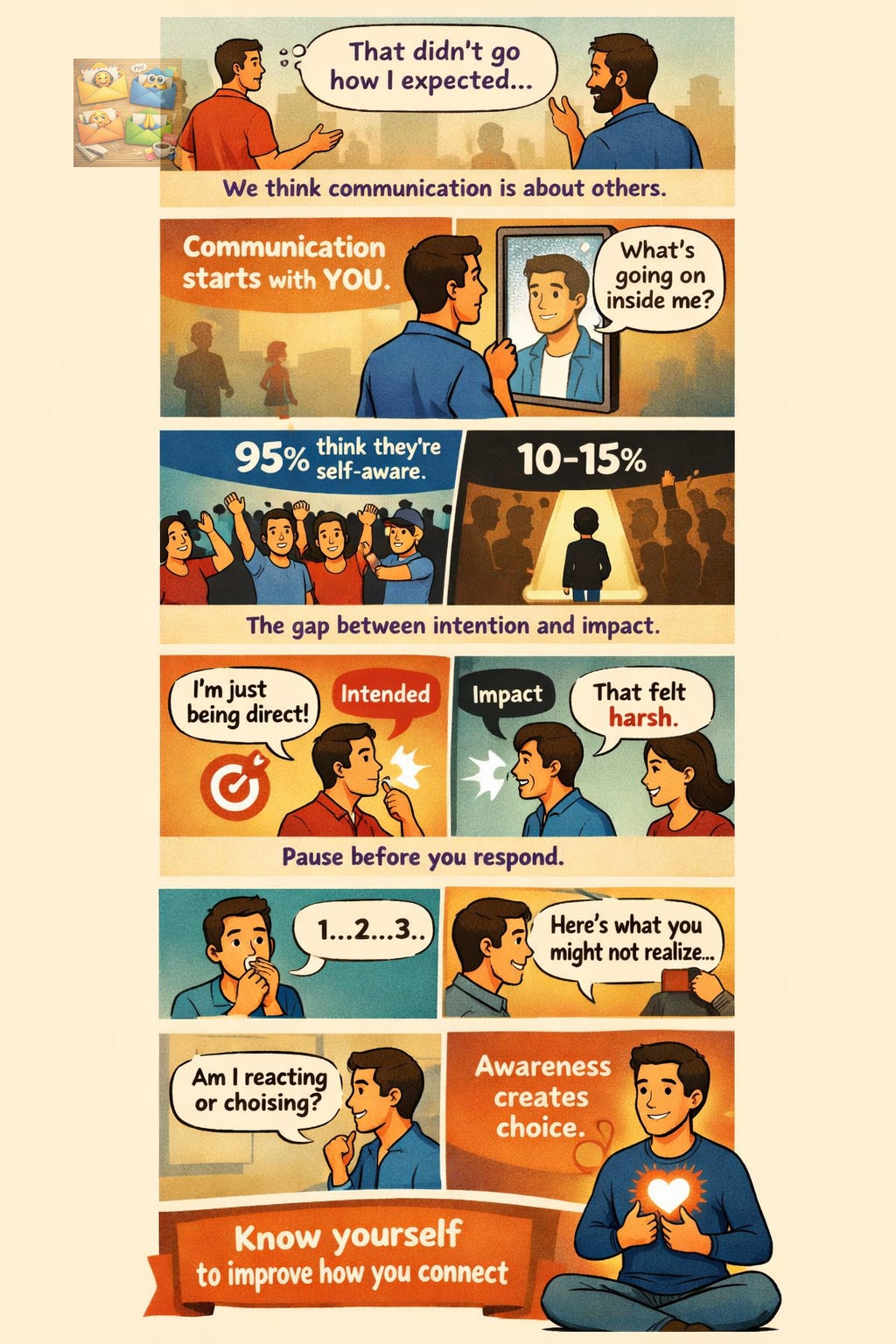
Have you ever walked away from a conversation thinking, “That didn’t go how I expected…”?
Maybe you felt misunderstood. Or maybe you realized later that your tone was sharper than you intended.
I’ve definitely been there. Bumpy road to make my idea heard, understood, and followed.
And I assumed that communication problems came from “not saying the right thing.”
But in reality, they often came from something deeper: not fully understanding myself while communicating.
That’s where self-awareness came in - and it changed everything. Not overnight.
It Starts With You (Not Them)
We usually think communication is about other people:
“How do I express myself better?”
“How do I get my message across?”
But communication is actually a mirror.
How you speak, react, listen, and even interrupt… all of it reflects what’s going on inside you.
Self-awareness is simply noticing:
What am I feeling right now?
Why did I react like that?
How might this be coming across?
When you develop this awareness, something powerful happens: You stop reacting automatically - and start choosing your response.
Research shows that when people understand their own emotions and reactions, they communicate more clearly, avoid misunderstandings, and handle conflicts more effectively.
The Hidden Problem: Most of Us Think We’re More Self-Aware Than We Are
Here’s the tricky part.
Studies suggest that a large majority of people believe they are self-aware - but only a small percentage actually are.
Researcher and organizational psychologist Dr. Tasha Eurich and her team found that while 95% of people think they’re self-aware, only about 10-15% actually are (Eurich, 2018). This means that many people are overestimating their level of self-awareness. Building Self-Awareness: Why It’s More Than Looking Inward | Psychology Today
And honestly, that makes sense.
Because self-awareness isn’t just about thinking about yourself. It’s about seeing yourself accurately - including your blind spots.
For example:
You think you’re being direct → others experience you as harsh
You think you’re listening → you’re actually preparing your reply
You think you’re calm → your body language says otherwise
That gap between intention and impact? That’s where communication breaks down.
J.K. Rowling and Turning Inward Before Speaking Out
Before becoming one of the most famous writers in the world, J.K. Rowling struggled - not just financially, but emotionally.
She describes herself as introspective and reserved. Instead of trying to force herself into a louder, more confident communication style, she did something different:
She leaned inward.
She spent long periods reflecting, writing, and understanding her thoughts and emotions before expressing them. That introspection - basically deep self-awareness - allowed her to communicate complex ideas and emotions in a way that resonated with millions.
What I learned:
You don’t need to “fix” your personality to communicate better.
You need to understand it.
Abraham Lincoln and The Power of Thoughtful Communication
Abraham Lincoln wasn’t the loudest voice in the room. He was known for being quiet, reflective, and deliberate.
But when he spoke, people listened.
Why?
Because he understood himself deeply - his values, his emotions, and the weight of his words.
That self-awareness helped him:
Choose words carefully
Stay composed under pressure
Speak with clarity and conviction
What I learned:
Communication isn’t about talking more.
It’s about aligning your words with who you are.
What Self-Awareness Actually Changes
When you become more self-aware, communication starts to feel different:
You pause instead of reacting
You listen to understand, not to reply
You notice your tone before it creates tension
You adapt your message depending on who you’re talking to
You also become better at something that’s often overlooked: empathy.
Research shows that people who understand their own emotions are better at recognizing and understanding the emotions of others.
In other words:
The better you know yourself, the better you understand everyone else.
So… How Do You Practice Self-Awareness Daily?
This is the part most articles skip.
Self-awareness doesn’t come from reading - it comes from practice. And yes, you don’t need hours of meditation.
You just need small, consistent moments.
Here are some realistic, everyday ways to build it:
1. Pause Before You Respond
This is the simplest and most powerful habit.
When something triggers you - pause. Take a deep breath (you can even count the 3 seconds of a longer inhale, and the 4-6 seconds of exhale).
And even 2–3 seconds is enough.
That pause creates space between emotion and reaction, helping you communicate more intentionally instead of impulsively.
2. Reflect on One Conversation Per Day
At the end of the day, ask yourself:
What conversation stood out today?
What did I do well?
What could I have done differently?
This kind of reflection helps you recognize patterns in your behavior and improve over time.
3. Notice Your Triggers
Pay attention to moments when:
You feel defensive
You interrupt
You shut down
Instead of judging yourself, get curious. Ask: “Why did that bother me?”
That’s where growth happens.
4. Practice Active Listening
Real listening is harder than it looks.
It means:
Not interrupting
Not thinking about your reply
Paying attention to tone, body language, and emotion.
Active listening improves relationships and builds deeper understanding because it focuses on both words and feelings.
5. Ask for Honest Feedback
This one is uncomfortable - but powerful.
Ask someone you trust:
“How do I come across in conversations?”
“Is there anything I do that makes communication harder?”
Don’t take it personal. Don’t take it as the law. Take it as it is: a different perspective.
Self-awareness isn’t just internal - it also comes from understanding how others experience you.
6. Start Checking in With Yourself
During the day, pause and ask:
What am I feeling right now?
Am I present, or distracted?
Am I reacting or choosing?
This kind of mindfulness strengthens awareness and helps you stay grounded in conversations.
So if you thought communication is tough…
Most communication problems are not about vocabulary, confidence, or technique.
They’re about awareness:
Awareness of your emotions
Awareness of your tone
Awareness of your impact
Once you have that, everything else becomes easier.
As communication researchers often point out, meaningful conversations rely not just on speaking clearly - but on listening deeply and understanding both sides.
And that starts within.
If there’s one thing to remember, it’s this:
“The quality of your communication is a reflection of the quality of your self-awareness.”
The more you understand yourself, the more intentional your words become - and the more meaningful your connections grow.
If you are ready to become a better communicator - you can join my next experience where we talk about leadership and how communication skills are the driving force behind it: Leadership Game Experience
Comments